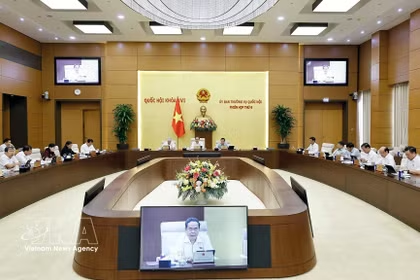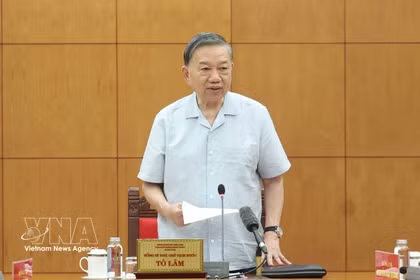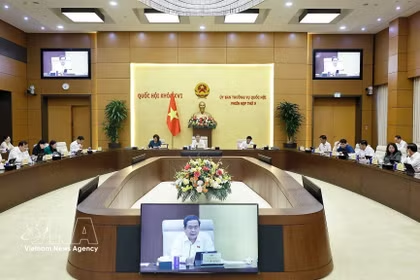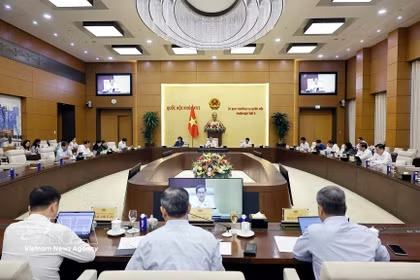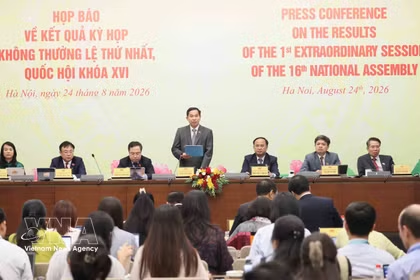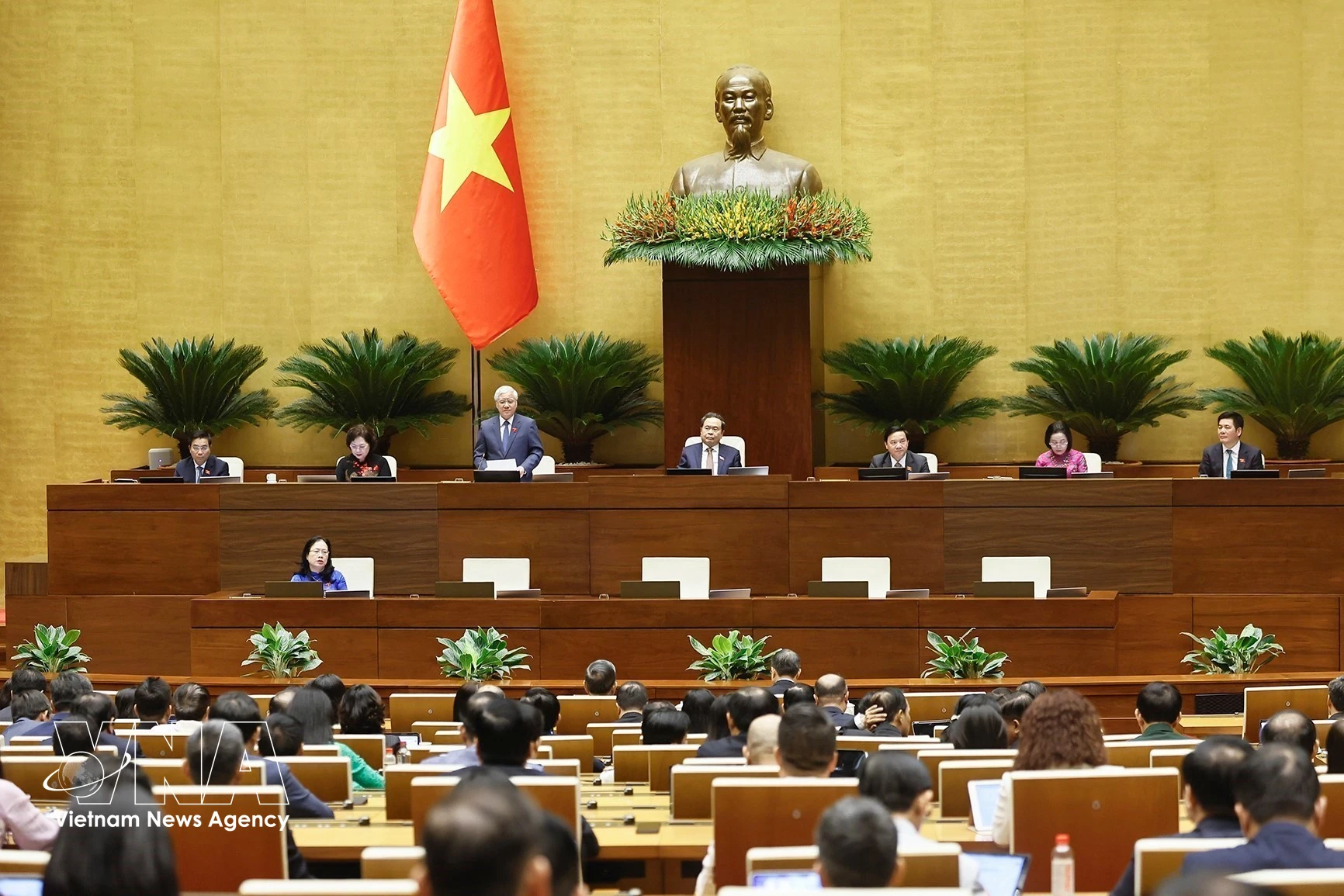
Hanoi (VNA) – The 16th National Assembly (NA) approved two laws and several resolutions covering administrative reform, infrastructure investment, urban development, innovation and crime prevention on August 24, part of its first extraordinary session.
One of the two adopted laws amends and supplements several provisions within 10 laws concerning administrative procedures and business conditions in agricultural and environmental sectors. The other amends and supplements some provisions of the Law on Vietnamese Guest Workers under Contracts.
The first law, passed with 93% of deputies in favour, covers the laws on crop production, plant protection and quarantine, animal husbandry, animal health, fisheries, geology and minerals, water resources, irrigation, meteorology and hydrology, and dykes.
Coming into effect on January 1, 2027, it removes business conditions on trading plant varieties and fertilizers, extends the validity of registration certificates for plant protection products from five to ten years, and boosts decentralisation by giving provincial authorities more control over veterinary procedures, rare livestock breed management, mineral mine licensing, as well as water resources-related procedures.
The second law revising the Law on Vietnamese Guest Workers under Contracts, passed with 476 of 477 participating deputies voting in favour, will take effect on March 1, 2027.
It prohibits service enterprises from collecting training fees before workers are selected and sign contracts with foreign partners. Enterprises must also ensure that the waiting period before departure for overseas employment does not exceed 180 days after selection, or compensate workers and refund collected service fees.
Workers will also be protected from double payment of social insurance contributions and personal income tax where Vietnam and destination countries have agreements preventing such duplication.
The NA also approved a resolution on special mechanisms and policies for handling legal violations related to the State-owned and private economic sectors, science – technology application, innovation, and digital transformation.
It provides mechanisms to exempt or exclude criminal liability for violations committed in the public interest, without personal gain or corruption, where material losses have been completely remedied. It also safeguards against risks arising from testing new technologies, innovation and digital transformation when prescribed preventive procedures have been followed.
This resolution takes effect on September 1, 2026 and applies for three years.
On infrastructure, the NA approved the investment policy for Ring Road 5 in the Hanoi Capital Region, with 463 of 470 participating deputies voting in favour.
The approximately 349km route will pass through seven localities, namely Hanoi, Ninh Binh, Hung Yen, Hai Phong, Bac Ninh, Thai Nguyen and Phu Tho, with preliminary investment estimated at 288.268 trillion VND (about 11 billion USD). Construction is scheduled to begin in 2027 and finish before 2035.
The NA also approved a resolution on adjustments to the investment policy for the Lao Cai–Hanoi–Hai Phong railway, raising preliminary investment to 289.339 trillion VND. The railway will feature standard-gauge double tracks on key sections and a maximum design speed of 160km per hour. It is targeted for basic completion by 2030.
Another resolution adopted on August 24 provides special mechanisms and policies for addressing obstacles facing projects serving the 2027 APEC Economic Leaders’ Week in Phu Quoc special zone, An Giang province. It allows shortened procedures to legalise and continue construction and capital disbursement for certain projects launched between March 2025 and May 18, 2026. The resolution takes effect on September 1 this year.
The legislature also passed the Law on Urban Development, with support from 465 of 474 participating deputies. Effective from October 1, 2026, the law sets mechanisms and policies for promoting the development of special-class cities, other cities, and special economic zones.
In addition, the NA adopted a resolution on the prevention and control of crimes and legal violations, operations of the People's Procuracies and the People's Courts, and judgment enforcement. It targets a 10% annual reduction in criminal cases related to social order and requiring all crime reports to be handled within statutory deadlines. It is set to come into force on January 1 next year.
It also approved a resolution allowing the relocation of two historical – cultural relic sites in Bac Ninh province to facilitate the construction of the road connecting Gia Binh International Airport with Hanoi. The resolution will take effect on September 20, 2026./.